Radio 2nd most accessed medium across metros, non-metros: Report
Radio is the second most accessed medium across metros and non-metros with listeners tuning in five days a week. Further,…
Rupa turns ninety this year. Rupa Publications, that is. I feel really proud to be associated with this renowned publishing house. They are the publishers of my two books, Decoding Didi and The Bengal Book.




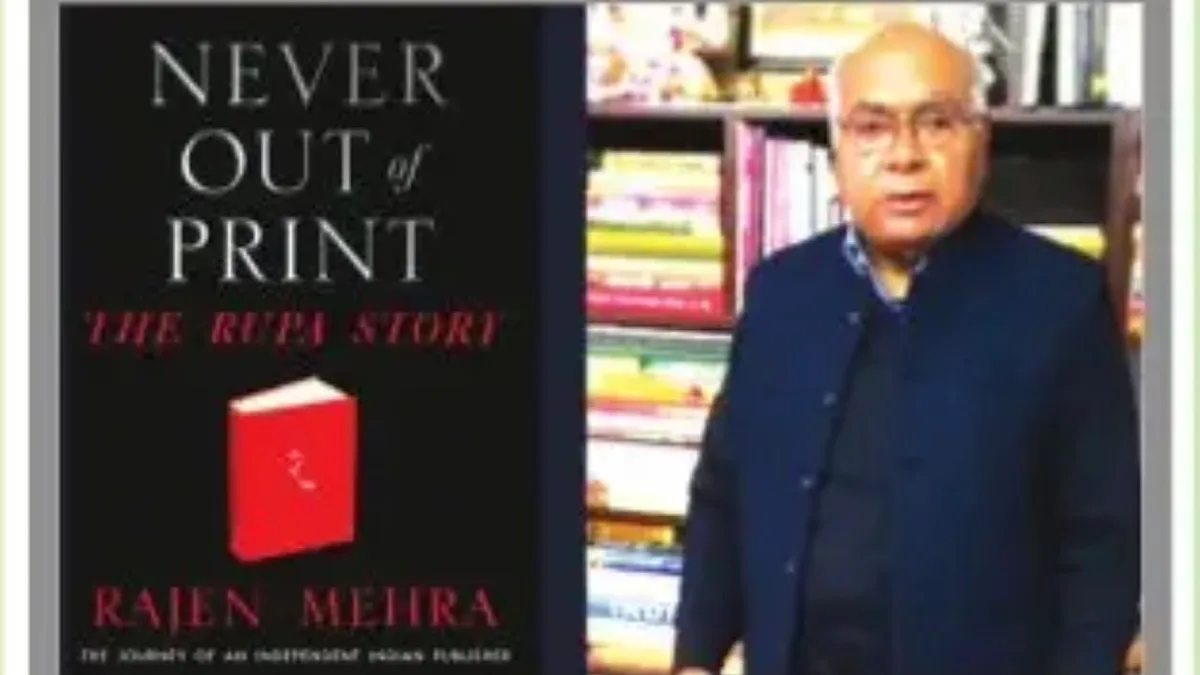
Photo:SNS
Rupa turns ninety this year. Rupa Publications, that is. I feel really proud to be associated with this renowned publishing house. They are the publishers of my two books, Decoding Didi and The Bengal Book. I was working for the national newsmagazine Outlook at that time and was really thrilled when I got an offer to write the books.
Rupa’s riveting story has been chronicled by Rajen Mehra, owner of Rupa, in his book, “Never Out of Print” (The Rupa Story: Journey of an Independent Indian Publisher) which came out last year.
It is a page turner of a tome.
Rupa’s journey began humbly on the sidewalks of Calcutta’s iconic New Market area where Daudayal Mehra (Rajen Mehra’s grand uncle), used to hawk hosiery. His talent as a salesman was spotted by a British man, who pursued him quite relentlessly and convinced him to switch to book selling. The sahib would not take no for an answer and the young man finally relented.
The rest is history.
Rajen Mehra came to Calcutta this week on the invitation of the Kolkata Book Fair. He has been conferred a lifetime achievement award by the publishing industry for his immense contribution.
What has struck me about Rajen Mehra even when I first spoke to him during the publication of my books is his disarming humility. Here is the head of an empire, who has his feet firmly on the ground. And that’s possibly the secret of his success.
Advertisement
I had occasion to meet Mr Mehra again this time when he came to Calcutta.
I wanted to interview him about his book and discuss the topic of publishing today.
He took time out from his packed schedule. I was running a little late. I Whatsapped him.
“Not to worry,” he messaged back. “I am sipping some nice Darjeeling tea. Take your time.”
Advertisement
I too sipped delightful Darjeeling tea and sitting in the mishti roddur or sweet sunshine of the Calcutta afternoon, asked away.
One of the questions I asked is whether the digital age is adversely impacting book publishing in the traditional physical form. And it was hearting to hear that one of the pioneers of the publishing industry in India who has a deep insight into the industry did not think so.
There are many many questions. Fortunately Rajan Da’s book answers many many of them.
Woven into the fabric of the fascinating personal, family story of how his granduncle Daudayal Mehra founded Rupa, are threads of the city’s and the country’s evolving history, its politics, economy, culture. Other than the intriguing account of the story of Indian publishing, the narrative is sprinkled with generous doses of humour in Rajen Da’s inimitable style. Understated. A quality, we come to know that he has imbibed from his illustrious granduncle.
Sample the following passage from the book where Rajen Mehra recounts his childhood:
“Every year we would spend our summer vacation in these UP towns and cities (Banaras, Allahabad and Kanpur). And every year it was the same train, the Toofan Mail, which took us to these destinations. This was a train which defied its name when it came to speed – it did not move at the speed of a storm or cyclone but chugged along at sedate pace. Our modest budget ensured that the family could not take a premium train like the Kalka-Howrah Mail, in which seats had to be reserved in advance. On the Toofan Mail, the reservation of your seat depended on how athletic your coolie was and how fast he could run and throw your luggage onto a seat. The Toofan Mail was a truly socialist, inclusive train. It would not differentiate between a big and a small station when it came to halting; it would stop at every station on the route. It would also stop in between stations because passengers were constantly pulling the emergency chain so they could get down at their villages and farms; the fact that the emergency chain was meant only for emergencies was cheerfully ignored.” (Page 29)
The book is studded also with a wide range of photos (including vintage book covers; old pictures from family albums and photos of the individuals and people who are mentioned in the pages; not to mention black and white illustrations and sketches of scenes depicted in the book.)
Rajen Mehra’s love for the city of Calcutta (something which I came to know of while speaking to him during the writing of my two books published by Rupa) is reflected in every turn of the page. The expression of deep admiration is an underlying aspect of it, tacit almost, as though echoing in between the lines.
(The writer is Editor, Features.)
Advertisement